Meet Our Student Awardees | 2025-2026—01.03.26
+
−
H+U+D is a joint effort among the Schools of Arts and Sciences (SAS) and the Weitzman School of Design whose objective is to promote synergies among the humanities and design disciplines. The initiative has “The Inclusive City” as its theme, focusing on issues of inclusivity and diversity, undergraduate and graduate students will receive small research grants to support interdisciplinary design/humanities projects in humanities and design disciplines that focus on the built environment. Resulting communities of interest, understanding and networks will endure beyond the life of the program.
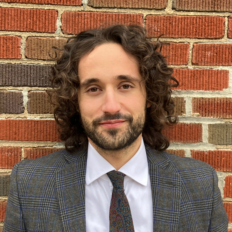 Andoni Perez-Lopez is a Ph.D. student in the Department of Spanish and Portuguese at the University of Pennsylvania. He holds an M.A. from the University of Colorado Boulder in Hispanic literatures and a second M.A. in literary and theatre studies from the Universidad Nacional de Educación a Distancia. His research focuses on the manifestation and evolution of socio-political constructs in cultural production in twentieth-century Spain. His interests also include the study of local mythologies and their role in the formation of Basque identities in response to Spanish national discourses.
 Anna Luurtsema is a third-year PhD student in the Department of Anthropology at the University of Pennsylvania. Her research examines the construction of heritage in the city of Holland, Michigan. Specifically, she is interested in how certain heritage narratives become privileged and naturalized through festivals, monuments, and collective memory, as well as how people challenge “official” narratives through their own heritage projects. She is excited to center community-engaged methods in her dissertation research. Anna is also an archaeologist and has participated in excavations in Mongolia, the Southern Levant, the Caribbean, and several sites across the United States.
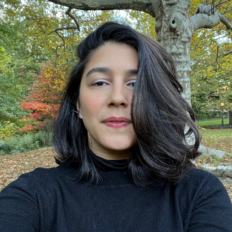 Clarisse Figueiredo de Queiroz is a Ph.D. student and Presidential Fellow in the History and Theory of Architecture at the University of Pennsylvania. Her research investigates how the built environment mediates the entanglements of extraction, cosmology, and state formation in modern and contemporary Brazil. Working across architectural history, anthropology, media theory, decolonial studies, and environmental humanities, she examines how colonial and Cold War infrastructures shaped territorial imaginaries in Brazil’s Northeast and North—and how Indigenous and local communities mobilize ritual, memory, and dreams to reframe those imaginaries, unsettling dominant regimes of knowledge and connecting Brazil’s internal “frontiers” to broader planetary histories of modernization, displacement, and ecological crisis across the Global South.

Dagny Elise Carlsson is a dual MArch and MLA student at the University of Pennsylvania, graduating in May 2027. As a proud citizen of the Cherokee Nation and the Shawnee Tribe, she is interested in alternative architectural design methodologies and processes that center on responsible land stewardship, respect for nonhuman relatives, and storytelling. Before Penn, she organized Stanford University’s first course on Indigenous architecture, “CEE 32XSI: Sustainable Design and Practice in Native American Architecture.”
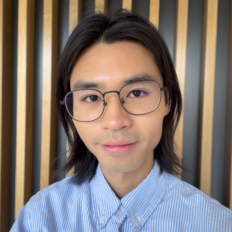 Dongsheng Li is a third-year Master of Architecture student at the University of Pennsylvania. His work lies at the intersection of architecture, media studies, and politics. Specifically, his research examines information infrastructure as a spatial and material force in shaping technopolitics and ideologies on a planetary scale, with particular attention to embedded gendered and labor conditions. Integrating with research, he is also interested in design and curation as media tools for social and spatial activism.
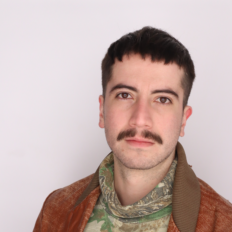
Enrique Urbina holds an MA in Comparative Literature from the University of Massachusetts, Amherst, and is currently a PhD student in the Spanish Program at Penn. His research interests include historical materialism, environmental studies, and Latin American literature. He was a Fulbright-Comexus grantee from 2023 to 2025.
 Evan Tims is a 2nd year PhD student in environmental and cultural anthropology. Prior to Penn, he was a Fulbright-Nehru Scholar in Kolkata and a Henry Luce Scholar in Nepal. During these fellowships, he developed his research and community engagement projects into the in100years project, a workshop series and publishing platform focused on the future of urban waterscapes in South Asia. He has published two anthologies of speculative climate fiction from students in Kathmandu and Chittagong, and hosted over a dozen workshops across Nepal, India and Bangladesh with over a thousand attendees. He also has experience working across a variety of nonprofit organizations and consultancies in addition to the NYC city government
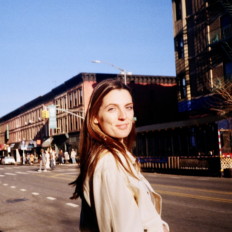 Madeleine Galvin is a doctoral student in the City and Regional Planning program at the University of Pennsylvania Weitzman School of Design. Her research focuses on race, redevelopment, and housing in the U.S. and France. She is interested in how citizen participation fits into the political economy of housing redevelopment, and studies how grassroots actors utilize the structure of public and social housing renovation programs to make claims to space, community, and place.
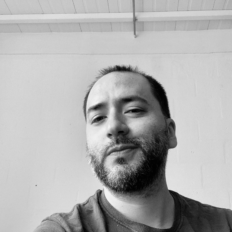 Marco Salazar Valle studied, practiced, and taught architecture in Ecuador (Universidad Central in Quito) with an interlude MSc in Advanced Architectural Design (Columbia University). Currently, I am a second year PhD. student in the Architecture, History, and Theory track at the Weitzman School of Design. In his research, he is interested in Indigeneity as a technoscientific representational ethos of twentieth-century mestizo modernity in the Andean region, constructed and contested through (rural) Indigenous spatial practices and struggles for (land, labor, and heritage) rights.
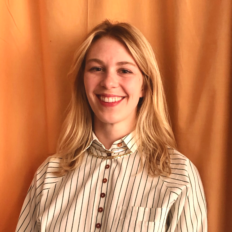 M.C. Overholt (co-curator) is a PhD candidate in the history and theory of architecture at the University of Pennsylvania Weitzman School of Design and a graduate of the Master of Environmental Design (MED) program at Yale University School of Architecture. Her scholarly work—which can be found in venues including Public Culture, Platform, and In the Daylight of our Existence: Architectural History and the Promise of Queer Theory (edited by S.E. Eisterer)—uses queer and feminist of color frameworks of analysis to reread interlocking histories of architecture and the sciences. She is a visiting assistant professor at the Pratt Institute, visiting lecturer at Bryn Mawr College, and a coeditor for Perspecta 57, the oldest student-edited architectural journal in the United States.
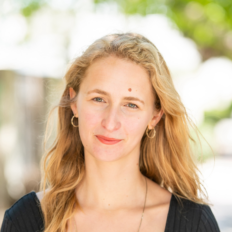
Nina Sparling is a first-year doctoral student in history at the University of Pennsylvania. She studies political economy in the 20th-century United States. Prior to pursuing doctoral work, Nina worked as an investigative reporter, covering migrant labor, tenant’s rights, and homelessness with support from organizations including PBS/FRONTLINE, the Fund for Investigative Journalism, and USC Annenberg Center for Health Journalism.
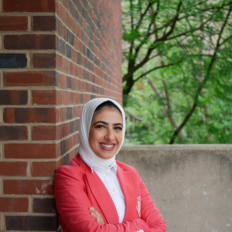
Nour Jafar is a PhD Student at the University of Pennsylvania’s Weitzman School of Design. Her work focuses on postcolonial theories, petro-landscapes, heritage preservation, collective memory, gentrification, and urban planning. Prior to pursuing a PhD in architecture, Nour worked for several years between Kuwait and Chicago as an architect within corporate architecture firms, focusing on transportation, commercial development and urban planning and design. She holds a Master of Science in Historic Preservation and a Master of City Planning from the University of Pennsylvania, and a Bachelor of Architecture from Kuwait University.
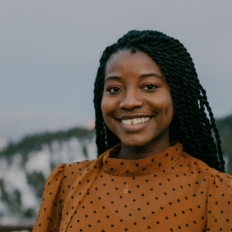 Sika Gadzanku is a Ph.D. Student in City and Regional Planning at the University of Pennsylvania. She is broadly interested in how clean energy transitions impact households and local economic development. She has several years of experience working in the renewable energy sector. At Penn, she studies the spatial, economic, and social impacts of emerging clean energy industries in Ghana and the United States. She holds a master’s degree in technology policy from MIT and a bachelor’s in chemical engineering from Tufts University.

Sydney Jones is a second-year dual Master of City Planning and Master of Urban Spatial Analytics candidate at the Weitzman School of Design, and the 2024-2026 Moelis Scholar. Her primary research interests include the different ways urban processes of growth and decline play out within Black communities. She is particularly interested in how housing functions as a mechanism for wealth extraction and dispossession.
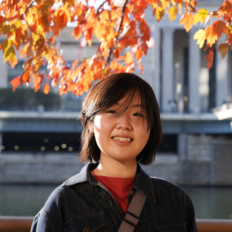 Zhijie Wang is a designer and dual-degree candidate in Landscape Architecture and Historic Preservation at the University of Pennsylvania. She strives to bridge academic inquiry with real-world landscape operations, turning research into systematic strategies for design, planning, and stewardship. Her research examines how metropolitan refuse lands can be understood as heritage, and how preservation might operate where stewardship is uneven and change is ongoing. In practice, she works to improve the cultural, ecological, and urban function of heritage landscapes in support of long-term resilience.